Copy the Principle, Not the Exact Thing
The single greatest mistake people make when seeking interior design inspiration is trying to replicate a curated photograph item for item. Direct copying almost always falls flat. A vintage velvet settee upholstered in a Ghanaian wax print might look breathtaking inside an 1890s Parisian apartment with ten-foot windows, herringbone parquet, and original ceiling medallions. But drop that exact settee into a 1980s suburban home with eight-foot ceilings and beige carpet, and it can suddenly feel heavy, out of place, or costume-like.
When you encounter an Afrohemian room that takes your breath away, look past the specific shopping tags. Ask yourself: What is the underlying structural rule making this room sing?
Is it the way a wide-scale geometric rug balances small-scale patterned pillows? Is it the friction between an industrial iron coffee table and a soft, fringe-heavy mud cloth throw? Is it the intentional choice to limit an intensely patterned room to a tightly controlled, two-color palette? When you extract the underlying design rule, you can apply it successfully to your own architecture, your personal comfort needs, and your existing furnishings.
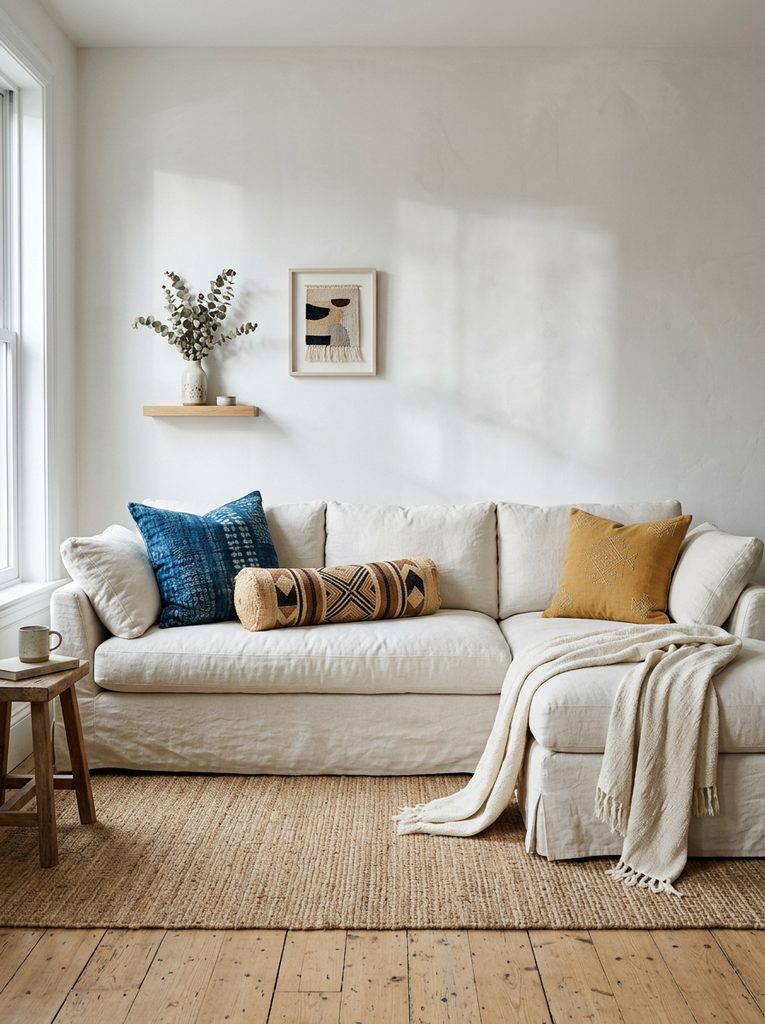
Use the guide below to translate the core principles of high-end Afrohemian spaces into choices that work seamlessly within your home.
| Instead of Copying This | Borrow This Principle | How to Apply It in Your Living Room |
|---|---|---|
| Buying an entire suite of matching tribal-print furniture | Scale Variation | Combine one large-scale pattern (like an oversized chevron rug) with one medium-scale motif (a geometric accent chair) and one micro-scale texture (an embroidered pillow). |
| Painting your entire living room a high-vibrancy saffron or cobalt | Color Saturation Through Accents | Keep your walls a soft, grounded neutral, and introduce intense pigments through swappable, artisanal drapery panels or oversized floor cushions. |
| Hanging dozens of small baskets in a random cluster across every wall | Curated Focal Grouping | Consolidate artisanal woven pieces onto a single architectural plane, leaving the surrounding walls uncluttered to let the collection shine. |
| Reupholstering your primary, daily relaxation sofa in rough vintage hemp | Strategic Tactile Placement | Keep your main sitting sofa upholstered in a durable, ultra-soft performance linen or velvet, reserving rougher, handwoven historic textiles for backings, bolsters, and ottomans. |
| Purchasing mass-produced, printed “boho” polyester pillow covers online | Artisanal Material Authenticity | Invest in just two hand-spun, vegetable-dyed authentic artisan covers. The genuine patina, hand-stitched seams, and textural depth will elevate everything around them. |
| Packing every tabletop with decorative brass figures and masks | Three-Dimensional Pattern Through Furniture | Use one functional, statement-making carved piece—like a Bamileke lattice side table—to introduce sculptural pattern without adding tabletop clutter. |